



When you’re faced with replacing a missing tooth, understanding dentistry bridges vs implants becomes essential for making the right choice.
This guide explores the key differences between dental bridges and implants, comparing costs, procedures, longevity and benefits to help you determine which tooth replacement option aligns best with your needs and budget.
What Are Dental Bridges & How Do They Work
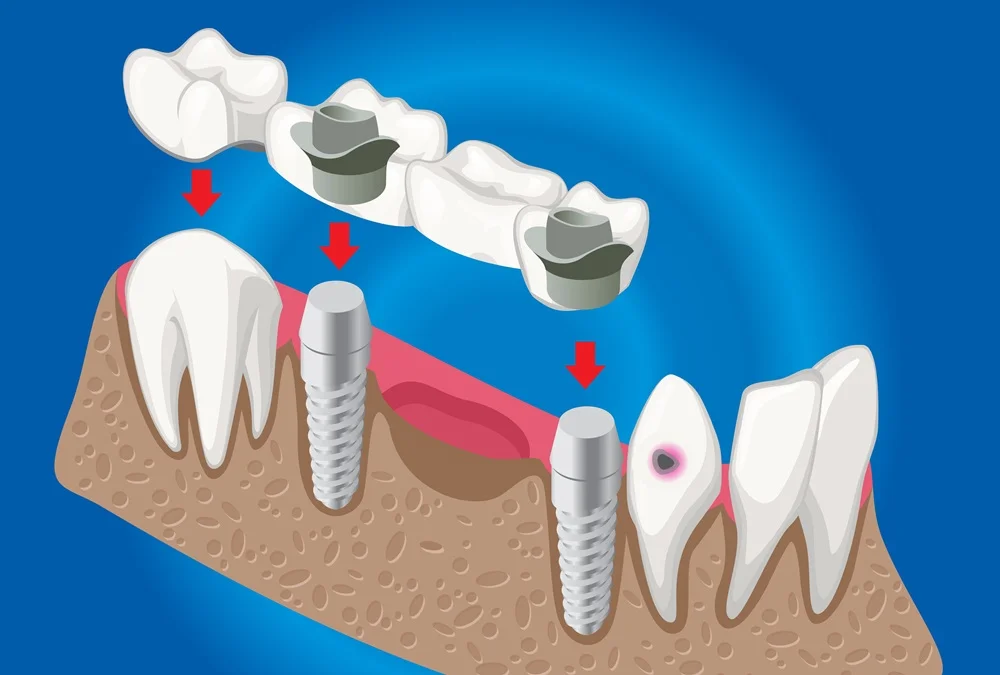
Dental bridges are prosthetic teeth anchored by crowns fitted over adjacent natural teeth, known as abutment teeth. The bridge literally “bridges” the gap left by missing teeth, using surrounding teeth for support. Custom-made from porcelain, metal alloys or combinations, these restorations match your natural teeth colour seamlessly.
The structure consists of a false tooth (pontic) held in place by crowns cemented onto adjacent teeth. This requires filing down healthy neighbouring teeth for crown placement. Once fitted, the bridge is fixed permanently and cannot be removed. Three main types exist: traditional bridges, cantilever bridges and Maryland bridges. For specific pricing on multi-tooth replacements, our 3 tooth bridge cost guide provides detailed information.
Bridges restore chewing function and appearance quickly, typically fitted within 2-3 dental visits over a few weeks.

What Are Dental Implants & How Do They Work
Dental implants are titanium posts surgically placed into the jawbone to act as artificial tooth roots. Following placement, these posts undergo osseointegration, where your natural bone fuses with the implant over 3-6 months, creating a stable foundation. Once healing completes, a crown is attached via a connector piece called an abutment, creating a standalone tooth replacement that doesn’t rely on neighbouring teeth.
The titanium post serves as the anchor, surgically inserted into your jawbone. After osseointegration, the abutment connects the implant to your replacement tooth, creating a self-supporting restoration that functions like a natural tooth root.
Implants provide the most natural-feeling tooth replacement because they stimulate the jawbone just like natural tooth roots, preventing bone deterioration that typically occurs after tooth loss.

Dentistry Bridges vs Implants: Key Differences Explained
When comparing dentistry bridges vs implants, the support structure differs significantly. Bridges rely on adjacent teeth for stability, requiring filing and crowning. Implants are self-supporting, anchored in your jawbone, leaving adjacent teeth untouched. Implants stimulate bone growth through chewing forces. Bridges don’t prevent gradual bone loss.
Bridges are non-surgical, fitted within 2-3 weeks. Implants require surgery and 3-6 months healing. Implants can last a lifetime with proper care, whilst bridges typically need replacement after 5-15 years. In our experience helping patients with tooth replacement decisions, understanding these fundamental differences proves essential for making the right choice.
Bridge vs Implant: Comparing Your Options
| Factor | Dental Bridges | Dental Implants |
| Treatment Time | 2-3 weeks | 3-6 months |
| Procedure Type | Non-surgical | Surgical |
| Adjacent Teeth | Requires alteration | Preserved intact |
| Bone Health | No stimulation | Prevents bone loss |
| Lifespan | 5-15 years | 25+ years to lifetime |
| Initial Cost (UK) | £500-£2,500 | £2,800-£4,000 |
| Maintenance | Specialized cleaning | Normal brushing/flossing |
| Success Rate | High | 95-98% at 10+ years |
Bridges vs Implants: Pros & Cons Breakdown
Understanding the advantages and disadvantages of dentistry bridges vs implants helps you choose the right option.
Dental Bridge Advantages
Bridges are less invasive with no surgery required. Treatment completes in 2-3 weeks. Lower initial costs suit tighter budgets. No bone density requirements needed. Patients unable to undergo surgery can still receive them.
Dental Bridge Disadvantages
Filing down healthy adjacent teeth permanently alters them. Bridges don’t prevent jawbone deterioration. The 5-15 year lifespan means future replacement costs. Supporting teeth become more vulnerable to decay. Specialized cleaning tools required.
Dental Implant Advantages
Implants prevent bone loss, maintaining facial structure. They don’t affect adjacent teeth. With proper care, implants last a lifetime. They function like natural teeth. Maintenance requires only normal brushing and flossing.
Dental Implant Disadvantages
Implants require surgery. Upfront cost of £2,800-£4,000 per tooth represents significant investment. Treatment spans 3-6 months minimum. Adequate bone density essential. Certain health conditions may prevent eligibility.
Dental Bridge vs Implant Procedures: What to Expect
Understanding the dentistry bridges vs implants treatment process helps you prepare for either option.
Bridge Fitting Process
- Visit 1: Examination, tooth preparation, impressions taken
- Adjacent teeth filed down and shaped for crown placement
- Temporary bridge fitted while permanent is made (1-2 weeks)
- Visit 2: Permanent bridge fitted, adjusted and cemented
- Usually completed within 2-3 weeks total
Implant Placement Process
- Consultation: X-rays, CT scans to assess bone density
- Bone grafting if needed (adds 3-6 months)
- Surgery: Titanium post placed into jawbone
- Healing: 3-6 months for osseointegration
- Abutment attached to implant
- Custom crown fitted
- Total timeline: 4-8 months
How Long Do Bridges & Implants Last: Longevity Comparison
When comparing dentistry bridges vs implants for durability:
- Dental bridges: Typically last 5-15 years
- Average lifespan: 10 years with proper care
- May need replacement due to wear or decay
- Dental implants: Can last 25+ years to lifetime
- Implant post rarely needs replacement
- Crown may need replacing every 10-15 years
- 95-98% success rate at 10+ years
Oral hygiene, regular check-ups, diet, smoking and teeth grinding all impact longevity. Excellent care maximizes lifespan for both options.
Dental Bridge vs Implant Cost UK: Investment Comparison
When evaluating dentistry bridges vs implants, cost represents a major consideration.
Dental Bridge Costs:
- Traditional three-unit bridge: £800-£2,500
- Maryland bridge: £500-£1,800
- Average cost per tooth replacement: £500-£2,500
Understanding dental bridge costs in the UK helps you budget appropriately for treatment.
Dental Implant Costs:
- Single implant (including post, abutment and crown): £2,800-£4,000
- Bone grafting (if needed): Additional £500-£2,000
Whilst implants cost more upfront, they often prove more economical over time. A bridge costing £1,500 may need replacement every 10 years. Over 20 years, you could spend £3,000-£4,500 on replacements. An implant costing £3,400 that lasts 25+ years eliminates these repeat expenses. For a detailed breakdown of pricing factors, see our complete guide to dental implant costs in the UK.
Many practices offer 0% finance options, spreading costs over 12-24 months. Private dental insurance may cover portions of both treatments.
Dentistry Bridges vs Implants: Key Takeaways & Next Steps
Understanding dentistry bridges vs implants empowers you to make informed decisions about tooth replacement. When choosing between dentistry bridges vs implants, consider that bridges offer quick, affordable non-surgical solutions, whilst implants provide superior long-term value through bone preservation and extended lifespan.
Key Comparison Points:
- Bridges: Faster treatment (2-3 weeks), lower cost, non-surgical, 5-15 year lifespan
- Implants: Longer process (3-6 months), higher cost, surgical, potential lifetime durability
- Bridges rely on adjacent teeth, requiring alteration
- Implants preserve neighbouring teeth untouched
- Implants prevent bone loss through stimulation
- Bridges don’t address bone deterioration
- Both restore function and aesthetics effectively
The right choice depends on your jawbone density, health, budget and long-term goals. Consulting experienced dental professionals ensures you receive the most appropriate solution.
Why Choose Trusmile for Your Tooth Replacement (35% Off Dental Implants)
Our Trusmile team provides expert guidance on dentistry bridges vs implants, helping you make the right choice for your smile. Whether you’re considering dentistry bridges vs implants, we offer extensive experience in both treatments, advanced 3D imaging and flexible payment plans.
We’re currently offering 35% off dental implants. Book your free consultation today to restore your smile with confidence.
Dentistry Bridges vs Implants FAQs
Which lasts longer, a dental bridge or implant?
Dental implants typically last significantly longer, with potential lifetime durability versus bridges’ 5-15 year average lifespan.
Are dental implants better than bridges?
Neither is universally better. Implants offer superior bone preservation and longevity, whilst bridges provide faster, less invasive treatment at lower cost.
What’s cheaper, a dentistry bridge vs implant?
Bridges have lower upfront costs (£500-£2,500) versus implants (£2,800-£4,000), but implants may cost less long-term due to extended lifespan.
Do dental bridges damage other teeth?
Bridges require filing down adjacent healthy teeth for crown placement, which permanently alters these teeth and may increase decay risk over time.
Can you get dental implants if you have bone loss?
Yes, bone grafting procedures can rebuild adequate bone density for implant placement, though this adds 3-6 months and additional cost.
How long do dental bridges last in the UK?
Dental bridges typically last 10 years on average with proper care, with lifespan ranging from 5-15 years.
Are dental implants painful to get?
Modern implant surgery uses local anaesthetic and sedation options, making the procedure comfortable with manageable post-operative discomfort.
Which is better for replacing front teeth, bridge or implant?
Implants are often preferred for front teeth as they preserve bone, maintain natural gum contours and eliminate visible metal frameworks.
Sources
NHS – Dental Treatments – Comprehensive guidance on dental bridges, implants and tooth replacement options available through the NHS
Bupa UK – Dental Bridges Treatment & Cost – Information on dental bridge procedures, costs and alternatives in the UK
Journal of the American Dental Association – Bridges, Implants, and Dentures – Clinical guidance on tooth replacement options and their applications